

Let’s stop pretending the world is going to hold itself together forever. Every year the power grid becomes more fragile, the people become more dependent, and the illusion that “somebody else will fix it” grows more laughable. You want survival prepper advice for long-term power outages? Fine. But understand this: if you’re asking now, you’re already behind. For years, the writing has been on the wall in big, blinking red letters—the grid is dying, and almost no one cares enough to prepare.
People act like the power going out for a few hours is an inconvenience. They whine that their streaming service paused or the AC cut off. But a real long-term power outage? A true grid failure that stretches into weeks, months, maybe longer? That isn’t an “inconvenience.” It’s the unraveling of modern civilization—fast, brutal, unforgiving. And most of the population will panic, consume everything in sight, and turn on each other the moment their comforts disappear.
If you want to survive what’s coming, you need to prepare like the world won’t help you—because it won’t.
The Moment the Grid Goes Down, Your Old Life Ends

People have no idea how many things they rely on daily that require power. It’s not just lights. It’s not just entertainment. It’s water treatment, sewage management, supply chains, hospitals, refrigeration, communication, and transportation systems. When the grid collapses, everything else collapses with it.
The very moment the power stays off longer than 24 hours, the fragile illusion begins to crack. Grocery stores lose refrigeration. Gas stations stop pumping. ATMs go dead. Electronic payments die instantly. After 72 hours, the shelves are empty, the water pressure drops, and the desperation kicks in.
And here’s the truth: your neighbors won’t stay neighborly.
When their kids are hungry and they realize the government isn’t coming to save them, they will do whatever it takes—whatever it takes—to survive.
If you’re not ready, you become the resource they want.
If you are ready, you become the target they need.
Either way, power outages change people. And not for the better.
Your Long-Term Survival Depends on Energy Independence—Not Hope
Hope is useless.
Backup generators? Sure, they’re great—until they burn through fuel. And when the grid is down for months, good luck refilling those tanks. Fuel becomes liquid gold, guarded, fought over, and nearly impossible to acquire.
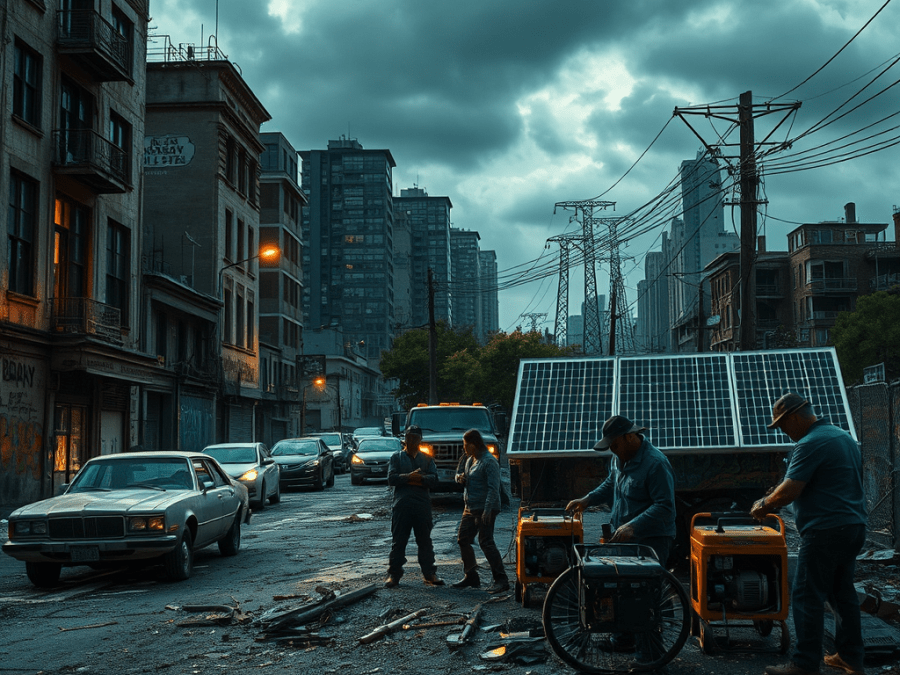
Solar? Better. But the average person buys a cheap solar generator thinking they’re set for life. They forget clouds exist. They forget batteries degrade. They forget that a single system can’t run a modern household.
Here’s the harsh truth:
If you want power long-term, you need redundancy—layers of energy options, not one toy you bought online.
Serious preppers follow this rule:
1. Solar Power (Primary)
Not a single panel. Not a cute portable kit.
A real setup: roof panels, ground arrays, battery banks, and proper inverters. Preferably something EMP-hardened or at least protected.
2. Fuel-Based Generators (Short-term and emergency)
Propane stores longer than gasoline. Diesel is stable. Gasoline is garbage after a few months unless treated and rotated.
Have multiple fuel sources, not one.
3. Manual Tools and Non-Electric Alternatives
Because eventually, everything breaks. And when it does, you’d better know how to live like electricity never existed.
Water: The First Resource to Disappear—and the Last You Can Live Without
People love stockpiling flashlights and candles while ignoring the most obvious issue: without power, water stops moving.
If you’re on a well? No electricity, no pump.
If you’re on city water? Once their backup generators fail, so does your faucet.
You need:
- Multiple water storage systems
- Gravity-fed solutions
- Water filters that don’t rely on electricity
- Backup manual well pumps
- Rainwater collection systems
And believe me, when people get thirsty, they’ll become unpredictable fast. A dehydrated population is a violent population.
Food Storage: Because Grocery Stores Won’t Save You
Everyone projects their fantasy onto collapse: “Oh, I’ll just hunt.”
Right. So will every other desperate person. Wildlife won’t last a month near populated areas.
Your real food sources must be:
- Bulk dry goods: rice, beans, oats, wheat berries, lentils
- Freeze-dried emergency meals
- Canned proteins: tuna, chicken, beef
- Gardens and greenhouses capable of long-term production
- Seed banks—heirloom only
- Livestock (if possible)
But you know what people never plan for?
The part where they get robbed.
If you store food, others will eventually want that food. So add this to your list:
- Hidden caches
- Decoy storage
- Defensive systems and training
- Community alliances (even if you hate people, you’ll need them)
Yeah, community. Even angry pessimistic preppers like me know one truth: you can’t defend anything alone forever.
Heat, Cooling, and the Harsh Truth About Weather
When the grid collapses, people forget how unforgiving nature can be.
Winter becomes deadly for the unprepared.
Summer becomes lethal for the weak.
You need non-electric heating systems:
- Wood stoves
- Pellet stoves (with manual lighting options)
- Thermal blankets
- Insulated emergency shelters
Cooling? That’s harder. But methods exist:
- Earth-sheltered structures
- Cross-ventilation
- Solar-powered fans
- Underground storage for perishables
- Heat-reflective materials
The wealthy think their backup generators will keep the AC going.
They won’t—not for long.
And when the heat becomes unbearable, they’ll be the first ones to panic.
Security: Because When the Lights Go Out, the Wolves Come Out
You can have all the supplies in the world, but if you can’t defend them, you’re just stockpiling for someone stronger.
Arm yourself. Train. Know your land.
Set up motion sensors, dogs, tripwires, perimeter alarms—systems that don’t need electricity.
And don’t fool yourself:
Morality is a luxury of stable societies.
When the grid dies, survival becomes the only rule.
Mental Fortitude: The One Prep No One Talks About
People break mentally long before they run out of food.
Isolation, fear, and the crushing realization that the world you knew is gone—that’s what destroys the unprepared.
You need hobbies, routines, skills, and discipline.
And you need to accept this now: life will never be easy again.
Final Thought: Prepare Like No One Is Coming—Because No One Is

Governments can barely handle a snowstorm.
You think they’ll manage a nationwide power collapse?
Look around. Society is soft, weak, and addicted to convenience.
They won’t survive long-term outages.
But you can—if you start now, prepare honestly, and stop trusting the world to keep the lights on.
Because once the switch flips for good, everything changes.
And only the prepared will make it through the darkness.
 TheDailyChristian