
You ever trust a government agency telling you the water’s fine? That it’s “perfectly safe to drink”? Well, if you’re the kind of person who sleeps through a blizzard in June and thinks the tap won’t betray you, close this window and go back to watching moose videos. For the rest of you—those of us who actually give a damn about staying alive in the Alaskan wilderness—let’s talk about the real state of Alaska’s drinking water and what you need to do to survive.
Because here’s the brutal truth: Alaska’s drinking water isn’t always safe. Sure, there are places with treated municipal water, but do you really trust every remote cabin, every village, every melting glacier? Hell no. Between natural contamination, failing infrastructure, mining runoff, and straight-up negligence, you’re on your own. And that’s exactly how a survivalist likes it.
So before you keel over from giardia or puke your guts out from heavy metals, let’s talk tactics.
15 Water Filtration Survival Skills You Need If You’re Not an Idiot
1. Boil the Hell Out of It
Bring that water to a rolling boil for at least one minute (three if you’re above 6,500 feet—yeah, a lot of Alaska is). That kills most parasites and bacteria.
2. Use a Gravity Filter System
If you’ve got a base camp, a gravity-fed filter like the Berkey or homemade system can crank out clean water while you sleep. No pumping. No babysitting.
3. Carry a Pump Filter
Lightweight, compact, and essential. I swear by my MSR Guardian—it filters viruses, bacteria, protozoa, and even sediment from glacial melt. No filter, no survival.
4. DIY Charcoal Filter
Don’t have gear? Layer charcoal from your fire, sand, and cloth in a container. It’s not perfect, but it’ll take the edge off toxins and odors.
5. Learn to Use Iodine or Chlorine Dioxide
These chemicals kill the nasties. Iodine tabs are lighter than filters, though they taste like a swimming pool. Still alive beats tasting berries.
6. Pre-filter with a Bandana or Shirt
Got glacial silt or scum? Strain that gunk out before it clogs your filter. Less crap = longer filter life.
7. Know Your Sources
Rivers near mining operations? Avoid them like a rabid wolverine. Look for high-altitude streams, snow melt, or springs.
8. Solar Water Disinfection (SODIS)
Clear PET bottles in direct sun for six hours—UV radiation zaps the bad stuff. It’s real science, not hippie voodoo.
9. Dig a Seep Well
Find a water source, then dig a few feet back and let groundwater seep in. You’ll avoid surface contaminants and turds floating downstream.
10. Sand and Gravel Filter
Layer sand and gravel in a column—like a bottle or pipe. Pour water through it to mechanically remove sediment and larger organisms.
11. Always Carry Backup Purification Tablets
Stash them in every kit, pocket, and ammo can. Filters break. Fires go out. Tablets just work.
12. UV Sterilizers (Like the SteriPEN)
Battery-powered UV light kills pathogens in seconds. Good for small quantities—especially when stealth is critical.
13. Catch Rainwater
Set up a tarp, rain fly, or your tent’s fly to funnel rainwater into containers. It’s usually clean enough to drink with minimal treatment—still filter it if you’re smart.
14. Make a Solar Still
Dig a hole, place a container in the center, cover with plastic, and let solar evaporation do the rest. It’s slow, but it’ll keep you from dying of thirst.
15. Use Natural Filters: Moss, Sandstone, and Charcoal
In an emergency, use what nature gives you. Pack moss and charcoal into bark or birch tubes, and filter slow. You’ll still want to boil it afterward.
3 DIY Survival Drinking Water Hacks for the Bush

You’re out there with nothing but your wits and what’s in your pack. Here are three down-and-dirty tricks that can save your hide:
Hack #1: The Plastic Bottle Distiller
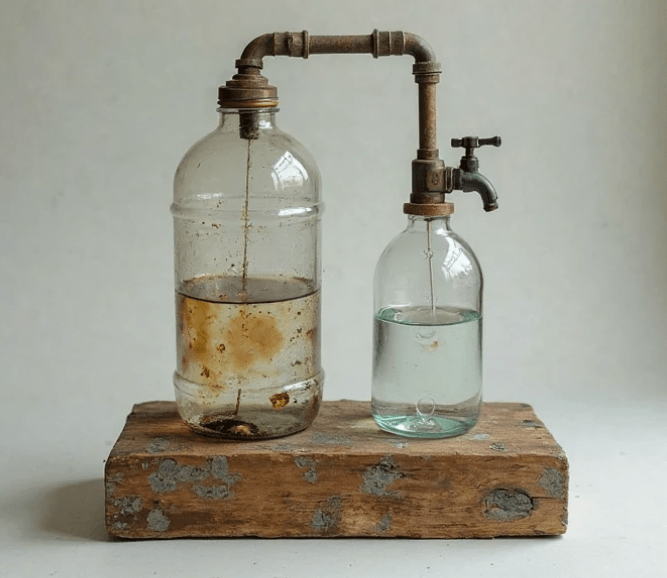
Take two plastic bottles. Cut one in half and put the dirty water in it. Connect the two using duct tape or a rubber seal. Set it near a heat source (like fire-warmed rocks) so the steam from the dirty side condenses into the clean side. It’s slow, but it can desalinate or purify almost anything.
Hack #2: Tree Transpiration Trap
Tie a clear plastic bag over leafy branches. As the sun hits, the plant releases moisture which condenses inside the bag. Drink that water. Just don’t pick anything toxic—don’t be dumb.
Hack #3: Fire-Baked Clay Filter
Shape some clay into a bowl and fire it in your campfire until it’s hardened. Mix in crushed charcoal before firing and you’ve got a primitive ceramic filter. It’s fragile but effective—if you’re not stupid and actually test it.
Alaska’s Water: What’s the Real Threat?
You think it’s just cold and clean because it’s “the Last Frontier”? Let’s break your fantasy.
- Rural Alaska still relies on untreated wells and surface water. Hundreds of villages don’t have piped water. They haul it by the bucket.
- Heavy metals and arsenic—especially in areas near old mines or natural deposits—can seep into groundwater. Arsenic doesn’t give you the runs. It gives you cancer.
- Melting permafrost and climate change are unleashing ancient pathogens. Think that’s a sci-fi problem? Ask the Siberians.
- Wildlife defecation upstream from your idyllic glacier stream is a guarantee. Moose, bears, and beavers don’t respect your thirst.
- Boil water advisories are common in rural areas during storms, infrastructure failures, or contamination spikes. But guess what? When the grid goes down, there’s no advisory at all.
Bottom Line: You’re on Your Own
If you’re living in or traveling through Alaska—especially off-grid—no one is coming to save you. Your life depends on the choices you make before you’re choking on creek water or huddled with diarrhea in a tent at -10°F.
Build your kit. Know your skills. Practice them when your life doesn’t depend on them. Because one day, it will.
What To Do Right Now:
- Inventory your water purification gear. If all you have is a LifeStraw, congratulations—you’re going to die eventually.
- Test your sources. Get a water test kit. Know if your well or creek is contaminated before your kidneys fail.
- Train your family. A good filter is useless if your kid drops it in the river.
- Stockpile purification tablets, extra filters, and emergency water. This isn’t prepper paranoia—it’s called not being helpless.
- Filter everything. Rain, snowmelt, tap water from a sketchy town—trust nothing that hasn’t been treated like an enemy.
You’re either prepared or you’re a liability. In Alaska, water isn’t just life—it’s life or death. Choose wisely.
 TheDailyChristian